How to Tell If Gold Is Fake: Simple Tests at Home
How can you tell if gold is fake when buying or checking your jewellery? Hallmark, magnet and weight checks, and why a jeweller's test is still the surest way.

Because of its high value and how easily it turns into cash, gold is also a target for counterfeiters. One of the things people who want to protect their savings most want to know is how to tell if gold is fake. The market can contain products that look very like the real thing but are made from worthless metals. So it helps to know gold's basic properties and some simple checks.
Some simple checks you can do at home give you useful clues. But none of them is conclusive on its own, and none replaces a check at a jeweller. Think of home checks as the first step in spotting a suspicious product.
The karat hallmark
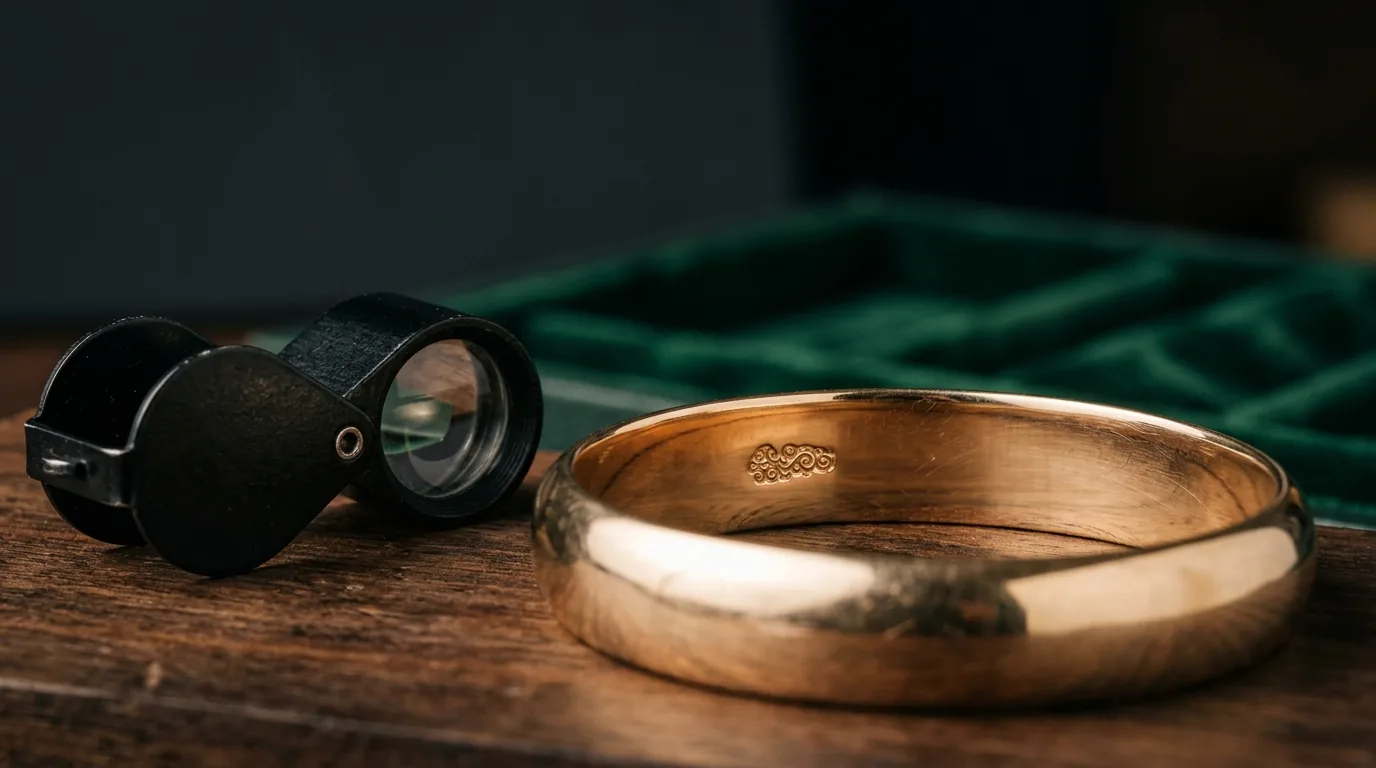
The first place to look is the karat hallmark. Most gold jewellery has a small stamp showing its purity somewhere discreet. Look inside rings, on necklace clasps or on the inner surface of bangles for numbers such as 916, 750 or 585, or marks such as 22K and 14K.
The hallmark should be crisp and readable. Be cautious with pieces whose mark is very faint or crooked, or that have no mark at all. You can find what the marks mean in our guide 14, 18, 22 and 24 karat gold. But since a fake hallmark can be stamped on a fake product, the hallmark alone is not enough proof.
The magnet test
Gold is not magnetic, so a magnet does not attract it. The quickest and most harmless check at home is to use a strong magnet. Strong neodymium magnets from a hardware shop give clearer results than weak fridge magnets.
If the piece itself sticks to the magnet, it contains a magnetic metal such as iron or steel, which is a serious warning sign. Clasps on necklaces and bracelets can contain steel springs, so it is normal for the clasp to react slightly; test the body of the piece. A piece not reacting at all does not prove it is real, because some worthless metals such as brass and copper are not magnetic either.
Checking the weight
Gold is a very dense metal. It should feel heavier in your hand than you expect for its size. When a fake and a real piece of the same size are compared, the fake usually feels lighter.
This check is easier with standard coins. For example, you know a quarter coin weighs about 1.75 grams. But to confirm this you need a scale accurate to 0.01 grams; kitchen scales usually cannot measure that precisely. Pieces that differ clearly from their expected weight are suspicious. Some fakes are made with metals of similar density to gold and can pass the weight check. You can find standard weights in how many grams is a quarter gold coin.
Discolouration and marks on the skin
Gold resists tarnish and rust. Real gold jewellery generally does not leave green or black marks on the skin; with lower-karat pieces, the copper they contain can occasionally leave a faint mark on some people. The copper, brass and nickel in fake jewellery, however, react with sweat and can stain the skin more often and more noticeably.
Also watch for peeling colour. On gold-plated fakes, the thin surface layer wears over time and a grey or reddish metal shows underneath. With real gold, even if the surface is scratched, the same colour shows beneath.
The streak test on ceramic
A method sometimes suggested is to rub the gold lightly on an unglazed ceramic surface. Real gold leaves a yellowish streak, while some fake materials may leave a dark grey or black one.
But this method can scratch the piece and cannot detect every fake. For a valuable piece, having it checked by a jeweller is better than doing this test.
Checks at a jeweller
Home checks always carry a margin of error. Well-made fakes plated with gold are also found on the market. To determine a piece's karat reliably, you need to have it checked by a jeweller.
One traditional method jewellers use is the touchstone and acid test. The gold is rubbed on a black touchstone, and solutions prepared for different karats are dropped onto the streak it leaves. How the streak reacts gives an idea of the gold's karat. Some jewellers can also measure it with an instrument.
Real and fake gold compared
| Check | Expected with real gold | Suspicious sign |
|---|---|---|
| Magnet | The body does not react | The body sticks to the magnet |
| Karat hallmark | Crisp, readable mark | Faint, crooked or no mark |
| Marks on skin | Usually none | Clear green or black marks |
| Surface wear | Same colour beneath | Grey or reddish metal shows beneath |
| Weight | Heavy for its size | Clearly lighter than expected |
None of these checks is conclusive on its own. If in doubt, the right step is a check at a jeweller.
How to stay safe when buying gold
The most effective way to avoid fake gold is to buy from trustworthy, identifiable sellers who issue an invoice or receipt. Products sold far below the market price, by hand or at the door, always carry a risk. Check current prices on our market page so you can be wary of abnormally cheap offers.
Remember to ask for a receipt showing the weight and karat of what you buy. For questions, visit our store in Ümraniye, Istanbul, or reach us through our contact page.
Frequently Asked Questions
Can you tell fake gold by its sound?
With coins, people sometimes listen to the sound when the coin is dropped lightly onto a hard surface; real gold is said to give a fuller, longer ring. But this takes experience, can damage the coin and is not conclusive.
Can you tell fake gold by biting it?
No. The bite test is an old belief based on pure gold being soft. Today's jewellery contains alloys, so the method does not work and can damage your teeth.
Can gold be tested with bleach?
No. Bleach can discolour gold alloys and damage the surface. That does not show the gold is fake. You should avoid testing with bleach.
At Erya Gold Kuyumculuk you can follow live buying and selling prices, and reach our store in Ümraniye with any question.