Diamond vs Cubic Zirconia: What's the Difference?
How do you tell a diamond from a cubic zirconia when buying a solitaire ring? The two stones compared for durability, sparkle and value.
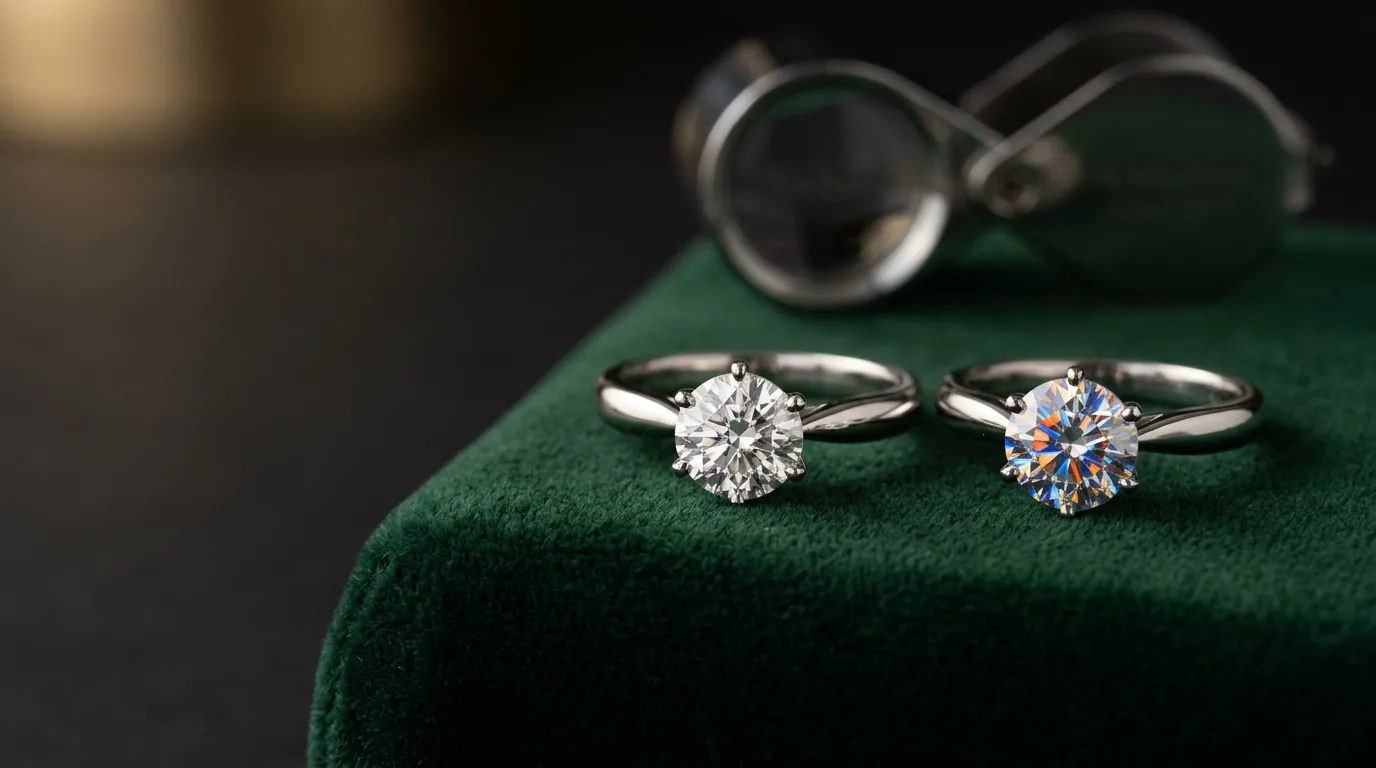
When you look at solitaire or five-stone rings, you meet pieces in the window that look very alike but differ hugely in price. The main reason for the confusion is that diamond and its most common alternative, cubic zirconia (called zirkon in Turkey), look very similar at first glance. But the similarity is only on the surface; the two stones differ a great deal in structure, durability and value.
Knowing the difference helps you use your budget well and predict how your jewellery will look over time. Before deciding, it is worth getting to know the basic properties of each stone.
Natural formation and laboratory production
A diamond is called a brilliant (pırlanta in Turkish) once it has been cut and polished. It forms from carbon deep in the earth under great pressure and heat and is carried to layers near the surface by volcanic processes. Most natural diamonds contain tiny natural marks left from their formation.
Cubic zirconia is not a natural stone. It is produced by crystallising zirconium dioxide in a laboratory and can be mass-produced at very low cost. Because it is made in a lab, it usually has no internal marks and looks flawless. One point not to confuse: real lab-grown diamonds also exist, but they are different from zirconia and are diamond in structure.
The difference in sparkle
The most striking feature of a diamond is the way it reflects light. A well-cut diamond reflects white light strongly while also splitting it into colours, creating a measured play of colour. We explain how the cut affects this sparkle in our diamond buying guide.
Cubic zirconia bends light less than diamond but splits it into colours more. So under light, zirconia gives a more colourful, rainbow-like sparkle. Side by side, a careful eye can see the difference between the whiter, more balanced sparkle of a diamond and the more colourful sparkle of zirconia.
Hardness and scratch resistance
One of the most important differences is hardness. On the Mohs scale of mineral hardness, diamond is 10, the hardest natural material. This makes it very resistant to scratching in daily wear. But a diamond can still chip at the edge if it takes a hard knock.
Cubic zirconia is between 8 and 8.5 on the Mohs scale. That is not bad for a jewellery stone. But with daily contact with hard objects, fine scratches can form on its surface over time, and over the years the stone can lose its shine and look duller.
Weight and density
Zirconia is noticeably denser than diamond. A zirconia of the same size weighs about 70% more than a diamond. For example, a zirconia the same size as a 1 carat diamond weighs about 1.7 carats.
That is why zirconia stones are usually described by their diameter in millimetres rather than in carats. A zirconia of the same carat weight looks smaller than a diamond.
Simple checks at home
Some simple checks at home can give you an idea whether a stone is a diamond or zirconia:
- Fog test: Breathe on the stone to fog it. Because diamond conducts heat very well, the fog disappears almost immediately. On zirconia the fog may last a little longer.
- Dot test: Place a loose, unset stone point-down over a dot on paper. Through a diamond you usually cannot see the dot; through zirconia you often can. This check cannot be done on stones set in jewellery.
None of these checks is conclusive. To know reliably what a stone is, have it tested with an instrument at a jeweller and, if possible, look for an independent laboratory certificate. For general checks against forgery, see how to tell if gold is fake.
Value and resale
The biggest difference between the two stones is their value. A diamond is a precious stone with documented characteristics, and there is a second-hand market for independently certified diamonds. But the price you get when reselling a diamond is usually well below what you paid. So a diamond should be seen not as an investment but as a lasting, precious piece of jewellery.
Zirconia is a low-cost manufactured stone with very little monetary value. When you sell gold jewellery set with zirconia, the stones are not counted; only the gold is valued. Zirconia has no second-hand value.
Comparison table
| Feature | Diamond | Cubic zirconia |
|---|---|---|
| Origin | Natural (lab-grown diamonds also exist) | Made in a laboratory |
| Hardness (Mohs) | 10 | 8 – 8.5 |
| Sparkle | Mainly white, balanced play of colour | More colourful, rainbow-like |
| Density | Reference | About 70% heavier for the same size |
| Resale | Certified stones have a second-hand market; price is usually below purchase price | Practically no value |
| Long-term wear | Highly scratch resistant | Can scratch and dull over time |
Which should you choose?
The choice depends on your budget and how you will wear the piece. For jewellery that will be worn for many years, such as for a proposal or an anniversary, diamond is often chosen for its durability. For fashion pieces worn to match an outfit, or where there is a risk of loss, jewellery with zirconia is a budget-friendly option.
Whichever you choose, ask for the stone to be clearly stated and written on the receipt. You can browse models in our catalogue and reach us through our contact page with any questions.
Frequently Asked Questions
Is a Swarovski stone the same as zirconia?
No. Zirconia is a crystal stone made in a laboratory. Swarovski is specially cut crystal glass. Being glass, it is softer than zirconia and scratches more easily.
Does zirconia go cloudy?
The stone itself does not tarnish. But soap, cream and sweat residue can build up on its surface and make it look dull. Fine scratches that form over time can also reduce its sparkle.
Are zirconia stones counted when selling a gold ring?
No. Zirconia has no resale value, so only the gold is valued. As we explain in what is the gold craftsmanship fee, payment is based on the amount of pure gold in the piece.
At Erya Gold Kuyumculuk you can follow live buying and selling prices, and reach our store in Ümraniye with any question.